Capital Oversight
Every active deal. Tracked against its locked baseline.
BidThis locks your underwriting at commitment and tracks material cost, timeline, and return variance through closing.
What Goes Wrong Without Oversight
Without a locked baseline, these problems compound quietly until closing.
How Capital Oversight Works
Lock underwriting baseline at commitment
Pricing, scope, timeline, and return assumptions preserved as the economic reference point.
Define financial guardrails
Cost, timeline, and exposure thresholds that trigger escalation when breached.
Monitor continuously
Every material shift measured against the locked baseline. Variance quantified in real time.
Escalate when thresholds breach
Capital impact is calculated. Stakeholders are notified. Action plans are documented.
Document final variance at exit
Full economic comparison of what was underwritten versus what actually happened.
Structured Lifecycle Reporting
Active reporting throughout the deal lifecycle, from commitment through closing.
Ongoing
Variance Summary
Current cost, timeline, and return variance measured against the locked baseline.
Active
Exposure Snapshot
Updated capital at risk and forward exposure as conditions shift during execution.
Continuous
Baseline Comparison
Side-by-side view of approved underwriting versus current position at each material change.
At Closing
Final Variance Report
Final record of what was approved, what changed, and the cumulative dollar impact across the deal.
Illustrative Variance Example
Projected Profit
$312K
Mid-Execution Variance
-$47K
Capital Impact
$265K
Guardrail thresholds breached. Escalation triggered.
Guardrail Breach Detected
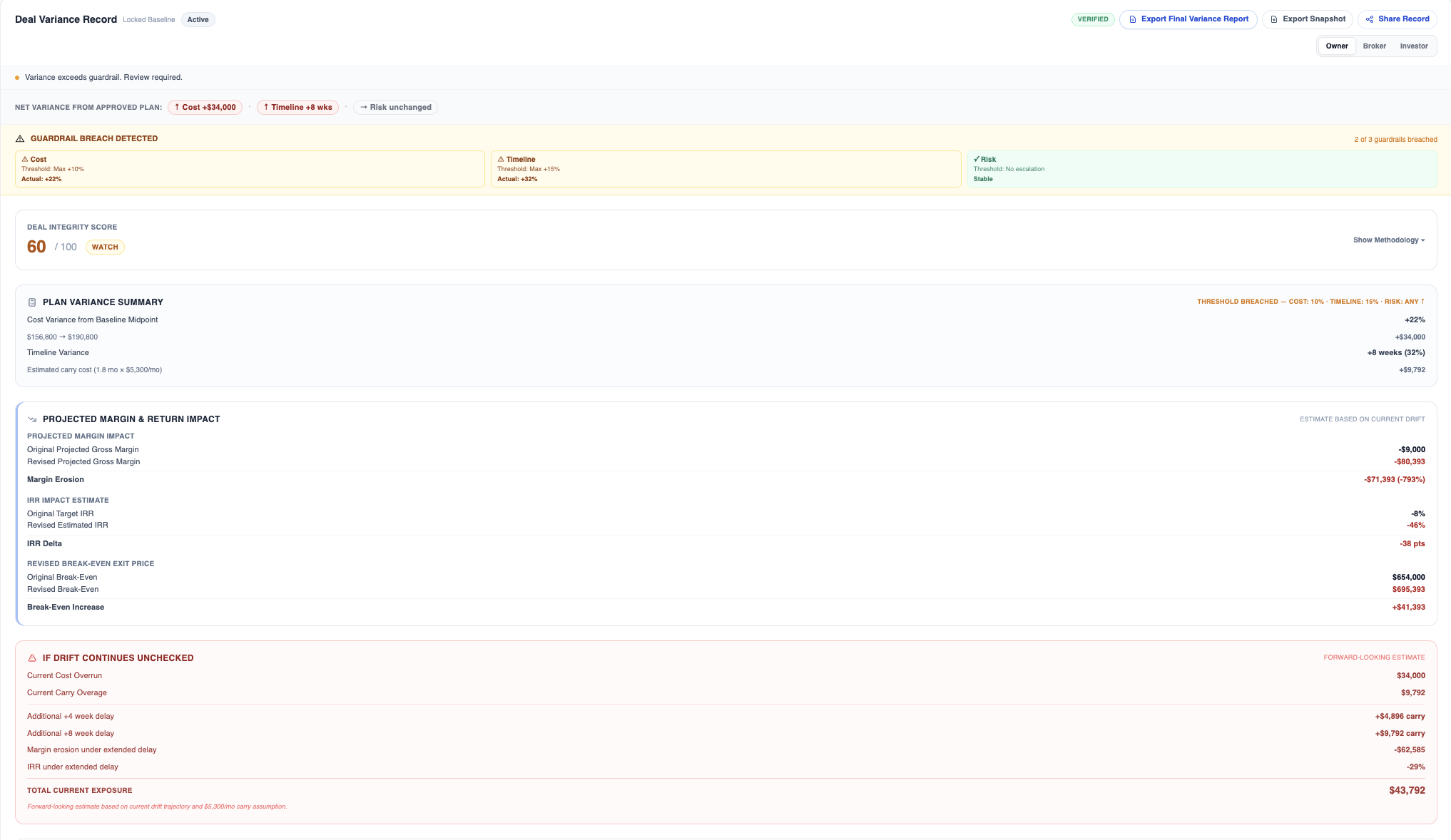
Cost and timeline thresholds exceeded. Margin erosion and forward exposure quantified against the locked baseline.
Without Structured Oversight (Illustrative)
- $92,688 total exposure
- No audit trail
- Deviation invisible until closing
With Baseline Enforcement (Illustrative)
- $43,792 exposure after correction
- $44,000 capital preserved
- Baseline enforced through closing
For Multi-Asset Operators
Portfolio-Level Capital Oversight
Single Engagement
Every deal starts here. Your underwriting is locked at commitment. Cost, timeline, and return variance is tracked through closing with timestamped reporting.
Portfolio Engagement
For operators running multiple active projects. Each deal has its own locked baseline. Cumulative variance is tracked across the full portfolio. Structured recurring engagement, not required for single deals.
Pricing
$1,950 per active deal
Ongoing monitoring from commitment through closing. Includes variance tracking, guardrail enforcement, and closing comparison report.
Typically under 0.1% of deployed capital.
Independent oversight from commitment through closing.
Baseline locked at commitment. Variance tracked through closing.
Structured escalation when thresholds breach.
Have a question? Call or text (512) 222-8257.